
If you or someone you love has recently been told they have scoliosis, the first thing you should know is this: you are not alone, and there is good reason for hope. Scoliosis is one of those words that can sound alarming at first, but once you understand what it actually means, how it develops, and what your options are, the path forward becomes much clearer. Here at ShoreLife Chiropractic & Wellness in Brick Township, NJ, Dr. Brett Tave works with patients of all ages who are navigating scoliosis-related concerns. Whether you are a parent worried about your child’s posture or an adult who has lived with back pain for years, this guide is written for you.
What is scoliosis? Scoliosis is an abnormal lateral curvature of the spine — meaning the spine curves sideways in a way it should not. Rather than a straight vertical line when viewed from behind, a spine affected by scoliosis may curve in an “S” or “C” shape. It can affect people of any age, and the type and cause of scoliosis vary widely from person to person.
Understanding Scoliosis: A Closer Look
The spine is an incredibly complex structure. It is made up of 33 vertebrae that stack on top of one another and are designed to provide both stability and flexibility. When viewed from the side, a healthy spine has natural curves — an inward curve at the neck, an outward curve at the mid-back, and an inward curve at the lower back. These curves help absorb shock and distribute body weight evenly.
Scoliosis, however, introduces a different kind of curve — one that goes sideways. In some cases, the affected vertebrae also rotate, which can cause the ribcage or shoulders to look uneven. The degree of curvature is measured in what is called a Cobb angle. A curve measuring 10 degrees or more is generally considered scoliosis. Curves under 25 degrees are typically considered mild, those between 25 and 40 degrees are moderate, and curves above 40 to 50 degrees are often classified as severe.
Here in Brick Township, NJ, Dr. Brett Tave at ShoreLife Chiropractic & Wellness sees patients across this entire spectrum. Understanding where someone falls on that scale is a critical first step toward creating an appropriate care plan.
The Main Types of Scoliosis
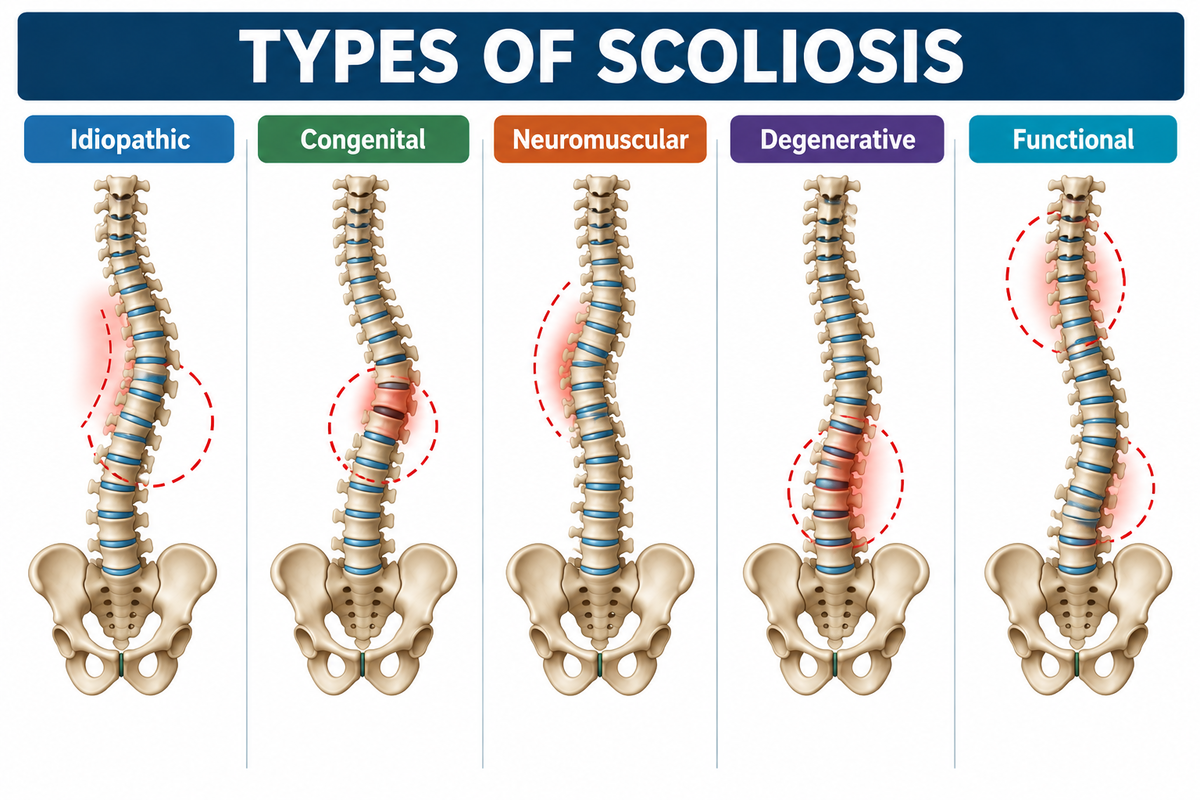
Not all scoliosis is the same. One of the most important distinctions a healthcare provider will make is determining which type a patient has. The type of scoliosis often determines the most appropriate approach to management and care.
Idiopathic Scoliosis
Idiopathic scoliosis is by far the most common type, accounting for the vast majority of diagnosed cases. The word “idiopathic” simply means the cause is not fully known or understood. Researchers believe it is likely influenced by a combination of genetic and environmental factors, though no single definitive cause has been confirmed. Idiopathic scoliosis is further broken down by age of onset.
Adolescent idiopathic scoliosis (AIS) is the most frequently diagnosed form. It typically appears during the rapid growth phase of puberty, between the ages of 10 and 18. Girls are more likely than boys to develop curves that progress to a degree requiring attention. Infantile idiopathic scoliosis is diagnosed in children under three years old, and juvenile idiopathic scoliosis occurs between the ages of three and ten. Early detection in these younger age groups is especially important.
Congenital Scoliosis
Congenital scoliosis develops before birth. It occurs when the vertebrae do not form properly during fetal development. Some vertebrae may be incompletely formed, fused together, or missing entirely. Because the structural abnormality is present at birth, this type of scoliosis is often identified early in life — sometimes even in infancy. Congenital scoliosis tends to progress more predictably than idiopathic forms and often requires close orthopedic monitoring.
Neuromuscular Scoliosis
This type of scoliosis develops as a secondary condition to a neurological or muscular disorder. Conditions such as cerebral palsy, muscular dystrophy, spinal muscular atrophy, and spinal cord injuries can all affect the muscles and nerves that support the spine. When those supporting structures are weakened or uncoordinated, the spine may begin to curve as a result. Neuromuscular scoliosis often progresses more rapidly and may involve longer curves that span a larger portion of the spine.
Degenerative Scoliosis
Degenerative scoliosis — also called adult de novo scoliosis — develops in adulthood, typically in individuals over the age of 40. Unlike idiopathic scoliosis, which begins during childhood or adolescence, this form is caused by the gradual breakdown of the spinal discs and joints over time. As the structures of the spine wear down unevenly, the spine can begin to tilt or curve to one side. This type is often associated with arthritis of the spine, disc degeneration, and compression of spinal nerves, which can cause significant pain and discomfort in the lower back and legs.
Functional Scoliosis
Functional scoliosis, sometimes called non-structural scoliosis, is different from the other types in that the spine itself is structurally normal. The curvature in this case is a secondary response to something else going on in the body — such as a leg length discrepancy, muscle spasm, or postural imbalance. The good news is that functional scoliosis may be correctable if the underlying cause is identified and addressed. This is an area where conservative care, including chiropractic, can play a meaningful role.
What Causes Scoliosis? Common Triggers and Risk Factors
As outlined above, the cause of scoliosis depends heavily on the type. For idiopathic scoliosis — again, the most common — the exact cause remains unclear, though genetics appear to play a significant role. If a parent or sibling has scoliosis, a child’s risk may be higher. However, having a family history does not guarantee a child will develop it.
For congenital scoliosis, the cause is a developmental abnormality in the spine that occurs during the first six weeks of fetal development. For neuromuscular scoliosis, the underlying neurological or muscular condition is the driving factor. For degenerative scoliosis, years of wear and asymmetrical loading of the spine are the primary contributors. Poor posture alone is not generally considered a direct cause of structural scoliosis, though it can contribute to functional patterns that affect spinal alignment over time.
Risk factors across types can include a family history of spinal conditions, rapid growth spurts in adolescence, certain underlying medical diagnoses, and age-related spinal degeneration. At ShoreLife Chiropractic & Wellness, Dr. Brett Tave takes a thorough history to understand each patient’s background and identify any contributing factors early on.
Signs and Symptoms to Watch For
Scoliosis does not always cause pain — particularly in its milder forms. In fact, many cases are first detected during routine school screenings or pediatric check-ups. That said, there are several signs that may indicate the presence of a spinal curve and warrant professional evaluation.
Visually, one shoulder may appear higher than the other, or one shoulder blade may protrude more noticeably. The waistline may look uneven, or one hip may sit higher than the other. In some cases, a person may appear to lean slightly to one side. When bending forward, a visible hump on one side of the back — caused by ribcage rotation — can sometimes be observed. This is known as a rib hump and is one of the hallmark signs a healthcare provider looks for during a physical exam.
Symptom-wise, mild scoliosis may cause little to no discomfort. More significant curves can lead to muscle tension, fatigue, and aching in the back — particularly after prolonged standing or activity. In cases where the curvature is affecting nerve function, patients may also experience radiating pain, numbness, or tingling into the legs. If you are noticing any of these signs in yourself or your child, it is worth having a professional evaluation sooner rather than later.
How Chiropractic Care Fits Into Scoliosis Management
Chiropractic care is a non-invasive, drug-free approach to supporting musculoskeletal health, and it can be a meaningful part of a comprehensive scoliosis management plan for many patients. It is important to be clear: chiropractic care does not “cure” scoliosis or reverse structural curves in the way that bracing or surgery might address severe cases. What it can do, however, is support better spinal function, reduce muscle tension, improve mobility, and help manage associated discomfort.
For patients with mild to moderate scoliosis — particularly idiopathic and functional types — evidence suggests that chiropractic adjustments, soft tissue work, and rehabilitative exercises may help support spinal mobility and reduce pain. A chiropractor will also assess posture, gait, and overall spinal mechanics to identify compensatory patterns that may be placing added strain on surrounding muscles and joints.
At ShoreLife Chiropractic & Wellness in Brick Township, NJ, Dr. Brett Tave evaluates each patient individually. No two spines are alike, and care is never one-size-fits-all. A thorough assessment — which may include postural analysis and orthopedic evaluation — helps Dr. Tave determine whether chiropractic care is appropriate and what a realistic, supportive plan might look like for that specific patient. In cases involving severe curves or neurological involvement, Dr. Tave will collaborate with or refer to appropriate medical specialists to ensure each patient receives the most complete care possible.
Practical Tips for Living Well with Scoliosis
Living with scoliosis does not mean living in pain or limitation. With the right habits and support, many people manage scoliosis very well. Here are some general recommendations that align with conservative care principles.
Staying active is one of the most beneficial things a person with scoliosis can do. Low-impact activities like swimming, walking, and yoga can help maintain core strength, flexibility, and overall spinal support. A strong core helps stabilize the spine and reduce the strain on surrounding muscles. Always speak with your chiropractor or healthcare provider before starting a new exercise routine to ensure it is appropriate for your specific curve type and severity.
Ergonomics matter significantly. Whether you are sitting at a desk, driving, or sleeping, how you position your body affects how your spine functions day to day. A supportive chair with lumbar support, keeping screens at eye level, and sleeping on a medium-firm mattress are all commonly recommended adjustments. Dr. Brett Tave can provide more personalized ergonomic guidance based on your specific spinal presentation.
Maintaining a healthy weight is also worth noting. Excess body weight can place additional stress on an already compromised spinal structure, potentially accelerating degenerative changes. A balanced diet and regular movement go a long way in supporting overall spinal health — not just in scoliosis, but in all musculoskeletal conditions.

When to See a Chiropractor
If you or your child has been diagnosed with scoliosis, or if you suspect there may be an issue based on the signs described above, a chiropractic evaluation is a reasonable and worthwhile first step. Chiropractic care is particularly well-suited for mild to moderate scoliosis, functional scoliosis, and scoliosis-related muscle tension and discomfort.
You should seek a professional evaluation if you notice visible postural asymmetry, experience persistent back or neck pain, or observe that a curve seems to be progressing. For growing children, regular monitoring is key — the adolescent years are a particularly important window because the spine is still developing and changes can happen quickly.
There are also situations that go beyond chiropractic scope and require urgent medical attention. If you experience sudden severe pain, loss of bladder or bowel control, significant weakness in the legs, or rapid progression of a known curve, please seek medical care promptly. Dr. Brett Tave at ShoreLife Chiropractic & Wellness is committed to honest, patient-centered care and will always communicate clearly if a referral is in your best interest.
|
Type of Scoliosis |
Typical Age of Onset |
Primary Cause |
Common Management Approaches |
|---|---|---|---|
|
Adolescent Idiopathic |
Ages 10–18 |
Unknown; likely genetic |
Monitoring, bracing, chiropractic, exercise |
|
Congenital |
Present at birth |
Vertebral malformation during development |
Orthopedic monitoring, possible surgical evaluation |
|
Neuromuscular |
Varies with underlying condition |
Neurological or muscular disease |
Multidisciplinary care, bracing, physical therapy |
|
Degenerative (Adult) |
Over age 40 |
Disc and joint degeneration |
Chiropractic, pain management, exercise, surgery in severe cases |
|
Functional |
Any age |
Postural imbalance, leg length discrepancy, muscle spasm |
Address underlying cause, chiropractic, corrective exercise |
Myths vs. Facts About Scoliosis
Myth: Scoliosis is always caused by bad posture or carrying a heavy backpack.
Fact: Poor posture and heavy backpacks do not cause structural scoliosis. While these habits can contribute to postural imbalances and general spinal strain, idiopathic scoliosis — the most common form — has no confirmed single cause and is believed to involve genetic factors. Functional scoliosis can be influenced by postural and muscular imbalances, but that is a distinct category.
Myth: Only teenagers get scoliosis.
Fact: Scoliosis affects people across all age groups. While adolescent idiopathic scoliosis is very common, scoliosis can also be present from birth (congenital), develop in early childhood (juvenile and infantile forms), or emerge in adulthood as a result of spinal degeneration. Adults in their 40s, 50s, and beyond are frequently diagnosed with degenerative scoliosis.
Myth: If a scoliosis curve is small, there is nothing to worry about.
Fact: While mild curves often require monitoring rather than aggressive intervention, “small” does not always mean “stable.” In growing children especially, a mild curve can progress significantly during a growth spurt. Regular check-ups and professional monitoring are important even when the curve appears minor.
Myth: Chiropractic care can straighten a scoliosis curve.
Fact: Chiropractic care does not structurally straighten a scoliosis curve, and any claim suggesting otherwise would be misleading. What chiropractic care can do is help manage associated pain, improve spinal mobility, reduce muscle tension, and support overall function. For growing patients with moderate curves, it is often used as part of a broader care plan.
Myth: Surgery is the only real treatment for scoliosis.
Fact: Surgery is generally reserved for severe curves — typically those above 40 to 50 degrees — or cases where the curve is significantly impacting organ function or quality of life. The majority of scoliosis cases are managed conservatively through monitoring, bracing (in children), chiropractic care, exercise, and pain management strategies.
Final Thoughts from ShoreLife Chiropractic & Wellness
Scoliosis is a complex condition, but it is also one that many people manage successfully with the right knowledge and care. Whether you are newly diagnosed, a parent with questions, or someone who has been living with scoliosis for years, understanding the type and cause of your condition is the first step toward making empowered decisions about your health.
Here at ShoreLife Chiropractic & Wellness in Brick Township, NJ, Dr. Brett Tave is here to help you navigate this journey with honesty, compassion, and thorough clinical care. Our community deserves access to clear information and conservative care options that genuinely support quality of life. If you have questions about scoliosis or would like to schedule an evaluation, we welcome you to reach out and start that conversation. You do not have to figure this out alone.
Frequently Asked Questions About Scoliosis
Can scoliosis go away on its own?
In some mild cases, particularly in very young children, curves can improve on their own as the child grows. However, most structural scoliosis does not resolve without some form of management. Monitoring and early intervention, when appropriate, are generally recommended to prevent progression.
Is scoliosis hereditary?
Research suggests that genetics play a role in idiopathic scoliosis. If a close family member has been diagnosed with scoliosis, your risk may be somewhat higher, though having a family history does not guarantee you will develop it. A professional evaluation is the best way to assess your individual situation.
Can adults develop scoliosis for the first time?
Yes. Degenerative scoliosis — also known as adult de novo scoliosis — develops in adults due to the gradual breakdown of spinal discs and joints. It is particularly common in individuals over 40 and can cause lower back pain, stiffness, and sometimes leg symptoms due to nerve involvement.
Is it safe to exercise with scoliosis?
For most people with mild to moderate scoliosis, exercise is not only safe but highly encouraged. Low-impact activities like swimming, walking, and core strengthening exercises are commonly recommended. It is always best to consult with your chiropractor or healthcare provider to make sure your exercise choices are appropriate for your specific curve type.
How is scoliosis diagnosed?
Scoliosis is typically diagnosed through a physical examination that includes postural assessment and the Adam’s Forward Bend Test, followed by imaging such as an X-ray to measure the Cobb angle of the curve. A healthcare provider will use these findings to determine the type, severity, and appropriate management approach.
Can a chiropractor help with scoliosis-related pain?
Many patients find chiropractic care helpful for managing the muscle tension, discomfort, and reduced mobility that can accompany scoliosis. While chiropractic does not change the structural curve itself, it can support spinal function and reduce associated pain. Dr. Brett Tave at ShoreLife Chiropractic & Wellness evaluates each patient individually to determine whether and how chiropractic care may be beneficial.
TL;DR — Key Takeaways
-
Scoliosis is an abnormal sideways curvature of the spine and comes in several types: idiopathic, congenital, neuromuscular, degenerative, and functional — each with different causes and management approaches.
-
Adolescent idiopathic scoliosis is the most common form, affecting children during growth spurts, while degenerative scoliosis is a common adult-onset condition caused by spinal wear and tear.
-
Chiropractic care does not straighten scoliosis curves but can help manage pain, improve mobility, and support overall spinal function as part of a broader care plan.
-
Warning signs include uneven shoulders or hips, a visible rib hump, and persistent back pain — all of which warrant professional evaluation.
-
Most scoliosis cases are managed conservatively; surgery is typically reserved for severe curves or significant functional impairment.